

Backscatter Radar Site in Christmas Valley, Oregon
By the 1980s the Cold War had been simmering for over three decades, and seemed likely to continue into the indefinite future. Technology had changed, however. Both sides still feared a surprise attack, but new possibilities had appeared. Instead of fleets of bombers, or ICBMs coming over the pole, an attack by low-level missiles, basically cruise missiles, loomed as a new threat. Such low-flying missiles could slink under the conventional radar net to appear without warning.
This facility, formally called the Christmas Valley Air Force Station, was specifically designed to address this threat. "Backscatter" radar could see potential threats beyond the horizon by reflecting radio waves off the Earth's ionosphere. These waves could then be reflected from potential threats, and those reflections in turn could be reflected back off the ionosphere to a receiver array. In effect the ionosphere becomes a radar mirror for looking over the horizon.
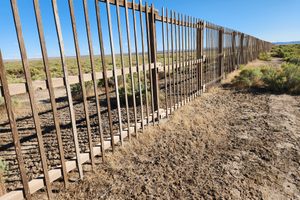
This installation was the transmitter array. It consisted of three transmitting stations, each enclosed by a wooden slat fence that was a square mile in area. Wood was presumably used because it's a non-conductor. The squares were arranged in an arc convex to the west, with a ~60º angle between the squares. The middle square was oriented with its northern edge slightly (about 30º) toward the southwest.
The installation was finished in the late 1980s just as geopolitical developments intervened. With the Cold War winding down, the array was never used for its intended purpose. Into the 1990s it found some use in tracking suspected drug smugglers, and NOAA also used it for research on the sea surface. The installation was finally decommissioned in 1997 and put into "warm storage." In 2002 it was completely deactivated; all the electronics were removed, but the wooden perimeter fences were left behind.
The site was then transferred to the state of Oregon, and it was proposed to use the area for green energy generation. This would take advantage of the enormous electrical transmission infrastructure that had been built to power the transmitters. Nothing came of these efforts, but the site is still partly used for research investigations. In about 2010 a small backscatter antenna array was built to study the upper atmosphere, the aurora in particular. This is operated by Dartmouth University and is part of a global net for upper atmosphere research.
In an ironic development, in 2025 the Air Force proposed rebuilding a backscatter radar at this site. Presumably present-day technology is a significant improvement over that from the 1980s, but the fact that a backscatter radar site is again thought to be necessary must reflect the shifting geopolitical realities since the end of the Cold War.