
Can AI make OCD worse?
The hidden cost of always agreeable, always available chatbots

I start researching this topic because of personal experience. As a diagnosed OCD patient, I have spent more nights than I’d like to admit staring at a chatbot, trying to get reassurance about the tiniest thing. (Is this little bump a sign of a tumor? I felt a small bump on my way home, how do I know I didn’t hit someone?) The same questions are rephrased again and again, for hours.
AI chatbots are always available, always friendly, always patient, and never judgmental. For most people, those are nice-to-have qualities. For someone with OCD, they might be what keeps the compulsion loop running.
Why chatbots get “misused” this way
OCD follows a predictable cycle. An intrusive thought creates distress. The person performs a compulsion, often a mental one like checking, confessing, or asking for reassurance. The distress briefly drops. The brain learns, incorrectly, that the compulsion is what kept them safe. Then the next intrusive thought hits later, sometimes even harder (source 1, source 2).
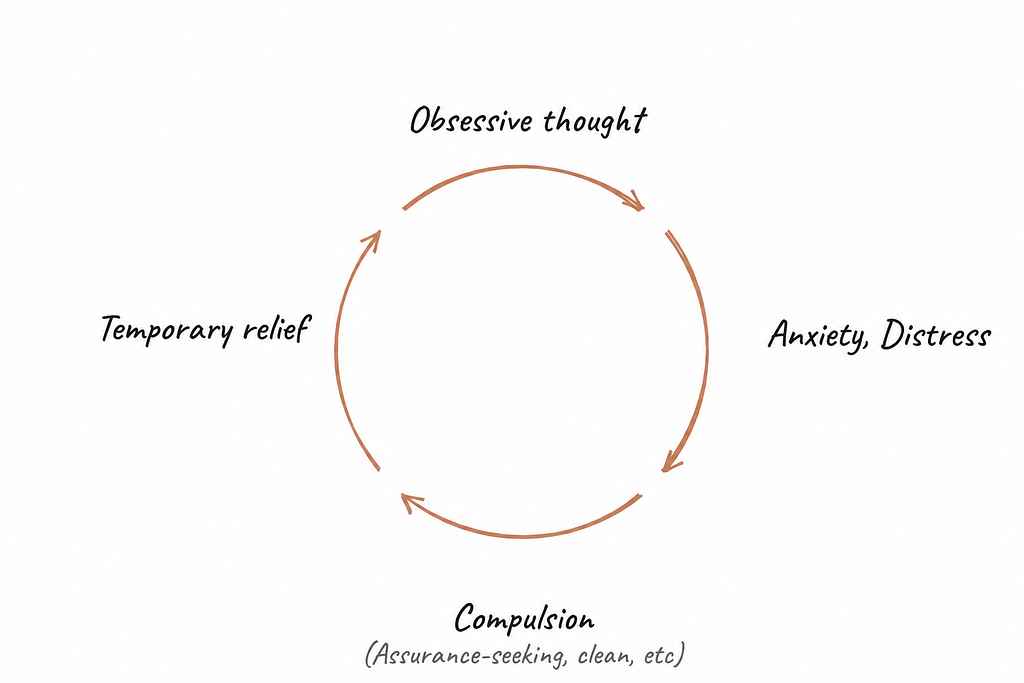
Reassurance-seeking is one of the most common compulsions. I still remember my therapist saying: the only way out is to embrace the uncertainty, because if there is even a 0.000001% chance that something might be true, the “what-if” train in my mind will not stop.
Friends and family eventually get tired of answering the same question. And unlike a search engine, chatbots provide direct, authoritative-sounding, fluent answers, which makes the reassurance more convincing and more reinforcing. Research in npj Digital Medicine also points out that chatbots tend toward sycophancy, meaning overly agreeable responses that align with what the user seems to want. For someone in a compulsion loop, an agreeable model makes it easier to keep the conversation going.
What clinicians and researchers are saying
Therapists treating OCD have started noticing this in their practices. Federico Ferrarese, a cognitive behavioral therapist in Edinburgh, noted that one patient reported spending upwards of ten hours a day seeking reassurance from chatbots. Another described the experience as a “massive wormhole.”
The Center For Hope and Health describes patients with health-focused OCD repeatedly asking ChatGPT about symptoms of brain tumors, people with moral or religious scrupulosity turning to chatbots for endless debates about whether they are a bad person, and parents with harm-focused OCD asking whether a small bump in the road could mean they hit someone.
On the research side, a 2025 systematic review flagged the risk that patient-facing language models could worsen reassurance-seeking and ritualizing behaviors. The American Psychological Association issued a health advisory naming OCD and anxiety as specific vulnerabilities, warning that AI chatbots may reinforce compulsive feedback loops.
What could be done differently?
An HCI paper frames this as a design failure rather than a user failure, arguing that safeguards need to be built into the default product. Right now, safeguards in general-purpose chatbots primarily focus on acute crisis scenarios like suicidal ideation and violence. Those obviously matter. But that focus leaves out the quieter harm of someone spending three hours rephrasing the same tiny question. Golden and Aboujaoude noted that there is no publicly available evidence of detection approaches for maladaptive reassurance-seeking, compulsive prompting, or looping in general-purpose models.
You cannot stop a user from asking a question, and you should not try to. But there might be some things that could help.
Detecting semantic repetition and adding friction
The simplest intervention is to detect when someone keeps asking the same question in slightly different words. In 2025, OpenAI rolled out a break reminder in ChatGPT that pops up during long sessions: “Just checking. You’ve been chatting for a while; is this a good time for a break?” It is a good first step, but it fires based on raw session length. Golden and Aboujaoude suggest that detecting rapid, repetitive re-queries of the same theme would be a stronger signal, and could trigger reflective prompts or a “low-engagement mode” that slows the interaction down.
There is precedent for this kind of friction in other products, even if for a slightly different purpose. For example, YouTube and Netflix show “Are you still watching?” prompts after users have been watching for a while. A study of streaming platform behavior found that features like autoplay remove natural stopping points, enabling mindless continuation. The prompt works against that pattern by forcing a tiny moment of self-awareness. Even though it can be easily dismissed, it interrupts the automatic flow. The same idea can be applied to OCD and chatbot interactions: an effortless behavior that happens without a conscious decision is harder to stop. A small interruption gives the user a chance to notice what they’re doing.

Patient-authored treatment preambles
A user, ideally working with a clinician, could write a standing set of instructions that the model honors across sessions. Something like: “Do not respond to my reassurance-seeking questions about my health. If I ask one, gently point me to my coping script.” The California OCD and Anxiety Treatment Center has proposed examples of what a healthier AI response might sound like: “I notice you have asked this in a similar way before. Could this be OCD pulling you toward reassurance? Would you like to reframe this as an ERP exercise?”
The key is that users would still decide whether to be redirected. The model should not make that choice for them.
Reducing sycophancy
Sycophancy may seem harmless in most use cases, but it becomes dangerous during a compulsion loop. Tuning models to tolerate disagreement, name their own uncertainty, and decline to give confident answers on ambiguous questions could make a difference.
Honestly, I originally hesitated to call this a design failure, because in a lot of ways this is just how the technology works. Large language models are trained to produce fluent, helpful, agreeable responses to whatever you feed them. Sycophancy is not exactly a bug. One reason it exists is that human raters tend to prefer responses that sound confident and accommodating, so the training process amplifies that tendency. Infinite availability is not really a design choice either. It is more just a property of the medium.
It is also fair to ask: why would AI companies bother with any of this? Users who loop use more tokens, which might be good for business in some cases. There is no obvious short-term incentive to slow those people down. But there is a growing public expectation that platforms should not be designed to maximize engagement at the expense of users. Social media companies have already been forced down this road. TikTok introduced a default 60-minute screen-time reminder for users under 18 after years of public pressure over teen mental health. Instagram launched Teen Accounts with built-in time-limit reminders, sleep mode, and content filters. Both changes occurred because of sustained public scrutiny, legal pressure, and growing concern about teen safety. The same pressure will eventually arrive for AI.
Still, there are things product teams can make choices about right now. How strongly to tune for agreeableness versus honest disagreement. Whether to detect repetition and introduce friction when it shows up. What the default response to a looping user looks like. None of these fixes would solve the problem entirely. But they could make the loop a little harder to fall into, and a little easier to step out of.
Can AI make OCD worse? was originally published in UX Collective on Medium, where people are continuing the conversation by highlighting and responding to this story.