

Denby Dale Railway Viaduct in Denby Dale, England
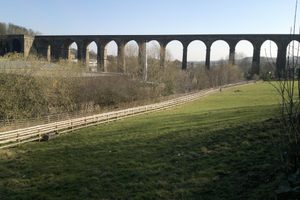
This impressive 21 arch viaduct is on a railway line currently called the "Penistone Line" and originally built in by the Huddersfield and Sheffield Junction Railway (later to become part of the Lancashire & Yorkshire Railway ). The valley of the River Dearne was a major barrier to the line between Huddersfield, West Yorkshire, England and the town of Penistone (NW of Sheffield) to join up with the Manchester, Sheffield and Lincolnsire Railway and so provide a shorter route to London via the North Midland Railway. The viaduct is 112 feet above the valley at its highest and the arches have a span of 40 feet. Overall the viaduct is around 1100 feet long. It is thus not particularly impressive even compared to other local viaducts, but the back story, and the remains of that story, is fascinating.
The original (1847) plan was to build the viaduct in Stone but the local suppliers demanded such high prices that the original viaduct was built from timber (another version of this story is that the local stone masons were on strike). Building railway infrastructure from timber rather than stone was a common expedient in mid 19th century railway building, The idea was to build a cheap ,if temporary, structure then either generate revenues to pay directly for the stone replacement or use the traffic figures generated to encourage further investment. The best example of this practice was the use of wooden structures (such as the Loughor Estuary Viaduct) by Brunel on the extensions into Wales of the GWR. It is not clear whether there was an intention, from the start, to upgrade the Denby Dale Viaduct to stone but in any event the upgrade seems to have been forced upon the company by local regulators.
The original wooden viaduct was, for the most part, a rather spidery trestle style viaduct which did little to inspire confidence, particularly because, during construction (in January 1847) a storm managed to collapse 27 of the 40 upright structures (this cost £5,000 to put right in 1848 prices). At each end of the wooden viaduct were abutments in the form of two stone arches and even here it seems that economy was preferred over structural stability. On the southern side of the valley the viaduct had to accommodate Barnsley Rd (now the A635) and on the northern side the Wakefield Rd (now A636) passed underneath. Instead of extending the abutment so the roads passed under a strong stone arch the trestle was weakened at each end by creating an arch in the wooden structure about 3 times wider than the normal separation of the uprights with a rather unattractive, and less than reassuring, "A frame" over it.
Even from the start there was a worrying amount of movement on the viaduct when trains passed over it and this was further not helped by the fact that maintenance of the wooden structure was less than rigorous. It was reported that as late as 1860 the bridge had had neither a coat of paint or an application of preservative. The timber had already started to decay. Famously, the viaduct wobbled so much that water buckets, required to be kept on the bridge in case the wooden structure caught fire, had to be re-filled daily because of water losses caused by passing trains.
The station was north of the viaduct and the local Alderman reported that many people, in fear of crossing the viaduct , would opt to travel to Wakefield (15 miles to the northwest, over bad roads at the time) rather than take the train southwards over the viaduct when travelling to London. The story of how the company were "persuaded" to replace the wooden structure is told in excellent detail by the "Huddersfield Exposed" website , involving an inspection by none other than the famous,Robert Stephenson.
Work started on the stone viaduct, built alongside the wooden structure on the inside of its curve (radius about 2600 ft), in 1877 with completion in 1884. Dismantling of the wooden structure around the same time. The stone structure was built over mine workings which had to be back filled after the structure was complete.
The timbers etc of the wooden bridge were sold off by auction, as were probably the masonry foundations as there is little trace on the valley floor today. The arched abutments at either end are however still visible as a lasting reminder of the wooden structure that put fear into the hearts of the locals.