

Grand Gulch Mine in Littlefield, Arizona
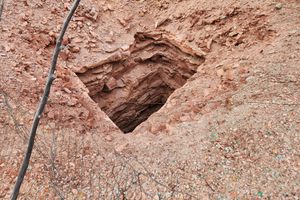
Copper, of course, has been known since antiquity, but it only became an important industrial metal in the latter 19th century with the rise of large-scale electrical technology. Previously copper deposits were worked only if cheap and accessible.
When the Grand Gulch deposit, then called Adam's Lode and marked by brilliant blue and green copper-bearing pebbles on the ground surface, was discovered after the Civil War, the shifting economics of copper led to mining beginning in 1872. Some of the ore concentrates assayed up to 75-80% copper, an extraordinary amount. The concentrates were freighted by wagon to the railroad line at St. Thomas, Nevada, whence they were shipped to smelters in Salt Lake City, Utah.
Even with increased demand for copper the operation remained marginal due to the transportation difficulties. Peak production, and profitability, only occurred during World War I. At this point some 80 people are thought to have lived by the mine, including the women and children in the miners' families. However, copper prices plummeted after the war due to the precipitous drop in demand, and the mine shut down in 1919. Coincidentally, the ore grade also dropped off at this point.
The mine underwent something of a revival in the early 1950s, when new technology—sulfuric acid leaching of the low-grade leftovers that were still heaped around the mine site—led to renewed production. Overall, some 6.6 million pounds of copper and 24,000 oz of silver were recovered from the deposit.
The deposit was hosted in a so-called "breccia pipe." Breccia (pronounced "BRETCH-uh", Italian for "broken") refers to a rock made of broken pieces of other rock. The breccia pipe formed when overlying rocks collapsed into limestone caves in the Redwall Limestone, hundreds of feet below the surface. The collapse then propagated up through the overlying strata. Such a column of broken rock can provide a conduit for metal-bearing solutions from deep in the crust, and these solutions in turn can precipitate metal deposits. There are around 1300 breccia pipes known in the vicinity, but only a few host metal deposits. Some breccia pipes host uranium mineralization, a fact of especial interest during the uranium boom of the early 1950s, but there proved to be no economic uranium mineralization at Grand Gulch. A couple of large abandoned dump trucks at the site date from this era.