

Møllestien in Aarhus, Denmark
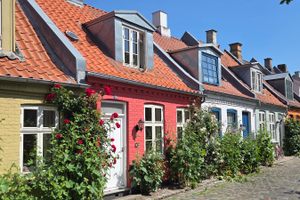
Møllestien is a narrow lane of 28 small, color-washed cottages running about 330 feet (100 meters) through the heart of Aarhus, its cobblestones edged by hollyhocks that climb the cottage walls. The street feels almost staged in its stillness. It was not always still.
The lane predates the 1200s and may follow the course of a path first established during the Viking Age. For centuries, it lay at the city's edge, where many of the city's outcasts ended up.
In 1686, three women from the lane were tried for witchcraft, accused of causing the death of the city bailiff. One died in prison, reportedly under harsh interrogation. A second was banished. The third was sentenced to be burned alive, but the punishment was commuted on the condition that she submitted to Church discipline, after which she disappeared from the street.
At the western end of Møllestien, where a small park now lies, a burial ground for criminals, paupers, and unidentified bodies operated during the same century. When the area centuries later was redeveloped, workers uncovered 38 skeletons beneath the ground.
In 1700, a widow on the street killed her two children and three visiting children with a knife. Her husband had the year before drunk himself to death in one of the lane's many illegal taverns. Local accounts portray the killings as tied to a street marked by chronic drinking and desperation.
Conditions remained extreme into the 1900s. By the 1920s, one family lived with only a loose stacking of stones in place of an outer wall. Prostitution was part of the same economy, and some houses still contain small staircase hatches described as lookouts for approaching clients.
The transformation came in the late 1950s, when artists and actors began moving in and renovating the houses and planting hollyhocks. When a private investor acquired seven properties with plans to replace them with a parking garage and supermarket, the newcomers successfully campaigned to stop the project.
What remains is a preserved fragment, one of the few places in Aarhus where 1800s working-class housing survives intact. Today, only about one house changes hands each year.